Em
Earth AbidesEm is Ish’s wife and one of the post-disaster community’s chief sources of courage: when argument, illness, or grief leaves others faltering, she helps them continue. Ish often measures her influence against his own education and plans, but comes to recognize a strength that neither formal learning nor abstract reasoning can supply. Remembered as Mother of Nations, she leaves behind not a doctrine but a way of meeting danger without surrendering care for the living.
Identity and Relationship with Ish
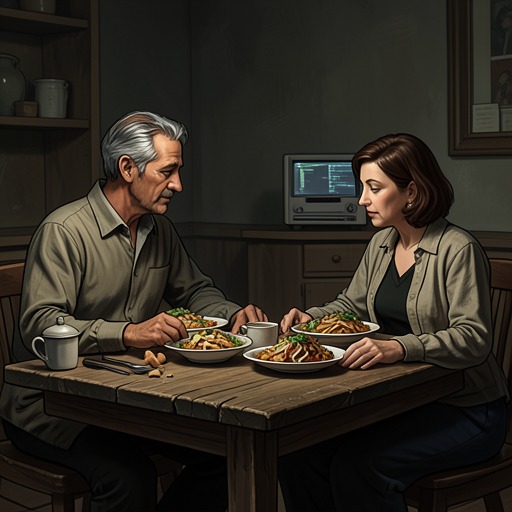
Em is presented through both her intimate life with Ish and the support she gives to people beyond their household. Her influence is not based on always agreeing with him. After Ish is humiliated by Charlie, he returns home bitter and lays down his hammer, which has ceased to feel like a symbol of authority. Em is waiting. They embrace, and Ish finds his confidence returning; he knows that even though they had argued about Charlie the night before, he can draw strength from her sympathy. He tells her what happened, and the emotional relief of being heard helps the sharpness of his humiliation ease.
Their closeness is reciprocal, but in moments of crisis Ish repeatedly finds himself leaning on Em. When he falls ill while Joey is sick, he wakes to discover that she has undressed him and put him to bed. He looks at her as a frightened child might, afraid that he will find fear in her face; instead, her calm steadies him. The scene makes visible a pattern that runs through their marriage: Em does not need to settle every question Ish raises in order to help him endure its consequences.
Judgment, Responsibility, and Conflict
Em’s moral authority is practical rather than scholarly. In the discussion about how to respond to Charlie, Ish tries to be fair and considers the possibility that sulfa pills might work, while the group confronts the danger of disease and the absence of an effective system for confinement. Em points out that the old law-books do not resolve the dilemma: their laws wait until an offense has occurred and then punish, but the harm has already been done. The question now, she insists, is whether the community can take responsibility for what follows, especially for the children.
When Ezra lays out the available choices, Em names them plainly: the community can vote for banishment or death. Paper, pencils, and four small ballots turn the discussion into a decision shared by those present. Em does not disguise the severity of the alternatives or pretend that inherited rules can decide for them. Her intervention helps make collective responsibility explicit, even as the vote forces the participants to bear the weight of choosing.
She also checks Ish when his fear of conflict risks becoming a struggle for control. When he senses trouble ahead over the attraction between Charlie and Evie, Em acknowledges that trouble may indeed come, but cautions him to make sure he is not the one who starts it. Her warning does not dismiss the danger; it turns his attention from predicting a crisis to examining his own possible part in it. In their household, disagreement can therefore function as a check on Ish’s authority rather than a withdrawal of affection.
Courage During the Epidemic
During the epidemic, Em’s care extends across the community. Ish recognizes that deaths have occurred but does not know who has died or how many. He hears a woman arrive in hysterical grief over a child, and sees Em give her the strength to go on. George comes in filthy and terrified because Maurine has suffered a relapse and their grandchild is gasping. Em says nothing about God, yet George leaves with his head held high. Her help is expressed less through instruction than through a steadiness others can draw upon.
Ish initially thinks of her as supplying no ideas and lacking the education or exceptional intelligence on which he once relied. The crisis revises that judgment: without Em, he believes, the group would have despaired and lost its hold on life. Her influence is not a claim that suffering can be explained or prevented. It is the capacity to help people continue when explanations have run out.
That capacity has a cost. Em tells Ish that, while he was sick, she faced the others repeatedly and alone. She had no arguments to offer; what she could give them was courage, and she describes that courage as flowing out of her while she grew weaker. Ish had spoken of Charlie during his fever, and his renewed doubt about the decision brings her exhaustion and pain into view. She refuses to support a return to the image of an angry, mean God who conceals the rules and punishes people for breaking them. Her appeal is not to abstract certainty but to the limits of human knowledge and the necessity of judging as well as one can with the understanding available.
Later Years and Death
Em continues to urge the community toward life as its circumstances change. When the question arises whether to admit The Others, some men fear disease, recalling Year 22, while younger men press for the union. Em, now wholly gray-haired, argues that their sons and grandsons will need wives and that the possibility of death must be faced rather than used to refuse every future risk. The community votes unanimously to admit The Others. They contract measles but recover, a concrete outcome that does not erase the risk Em asked the group to accept.
As she lies weak and in pain, Em is still the one comforting Ish. She reassures him about the children and grandchildren, telling him that they will be happy and will go on, whether or not the civilization he hoped for returns. Her words redirect his attention from the fate of a particular social order to the continuance of human life. Watching the younger generations pass her bedside, Ish recognizes the force of that confidence.
At her death, Ish holds her hand and feels her fingers flutter once. He thinks of her as Mother of Nations and understands that the source of strength he depended on is gone. Their custom is to bury her without a marker. The absence of a monument contrasts with the scale of her influence: she has sustained individual mourners, helped shape decisions affecting the community, and comforted Ish through the end of her life. For him, her death marks the passing of a greatness that had been present not in public office or formal teaching, but in her repeated readiness to bear pain and give others courage.
Narrative Significance
Em provides a counterweight to Ish’s confidence in systems, plans, and learned explanations. She does not replace judgment with instinct: in the decision about Charlie, she confronts the limits of inherited law and insists that the community face its responsibility. But she also refuses to let fear, certainty about punishment, or an ideal of restored civilization become reasons to deny life. Her interventions repeatedly shift attention from what people can explain to what they must do for one another.
Her importance is conveyed through consequences rather than a formal position. A grieving woman leaves able to fight on; George leaves with renewed composure; Ish recovers confidence after humiliation and, later, reassurance during illness. Em’s influence is sometimes described as a spirit passing from her to others, while the narrative also shows its cost in her exhaustion. By naming her Mother of Nations, Ish gives symbolic form to a role she has enacted through care: she sustains a community’s ability to endure loss, accept risk, and continue into a future she will not see.